By Ben Eborn, Publisher, North American Potato Market News
Growers have many things to consider when making planting decisions for the 2026 potato crop. Some of the major factors include current and projected potato prices, prices for alternative crops, production costs, contract volumes, irrigation water supplies, land availability and crop rotations.
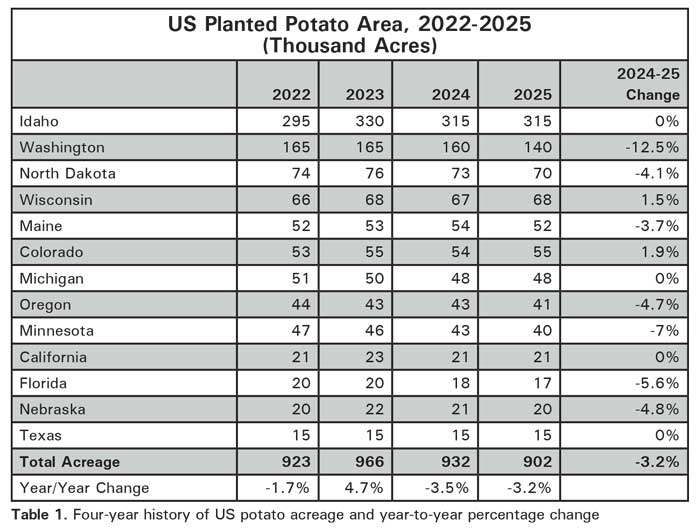
Table 1 shows a four-year history of U.S. potato acreage by state, along with the year-to-year percentage change. In this article, we review some of the key factors influencing 2026 planting decisions.
Alternative Crop Prices
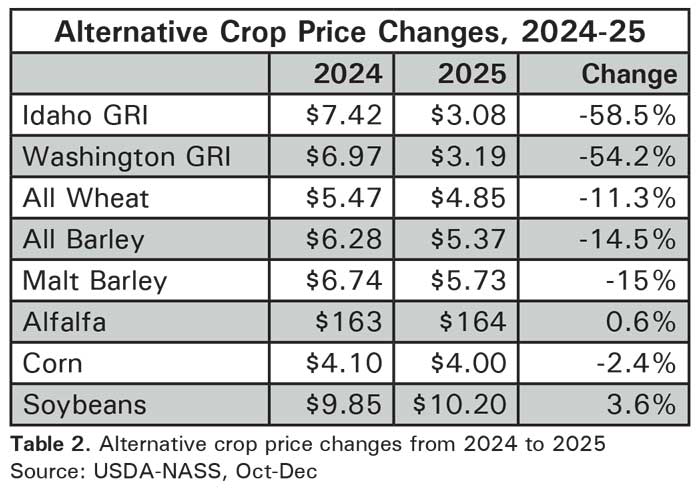
Extremely low open-market prices for the 2025 potato crop could encourage growers to plant fewer acres to potatoes in 2026. The average Idaho Russet Grower Returns Index from October through December was $3.08 per cwt, down 58.5% from $7.42 per cwt a year earlier. The Washington GRI averaged $3.19 per cwt during the same timeframe, down 54.2% from the previous year.
Prices for several competing crops are also down from where they were a year ago. USDA reports that the national all-wheat price averaged $4.85 per bushel during the October-December period versus $5.47 per bushel a year ago, an 11.3% decline. All-barley (-14.5%) and malting barley (-15.0%) prices are also down. Nationwide, alfalfa prices are relatively flat at $164 per ton. Corn prices are down 2.4% to $4 per bushel, while soybean prices have increased 3.6% to $10.20 per bushel.
Growers may consider significant open-market potato acreage cuts this year due to extremely low prices. Though current prices for most alternative crops are near breakeven, they are relatively stronger than open potato prices. In addition, input requirements and financial risk are significantly lower for most alternative crops.
Production Costs
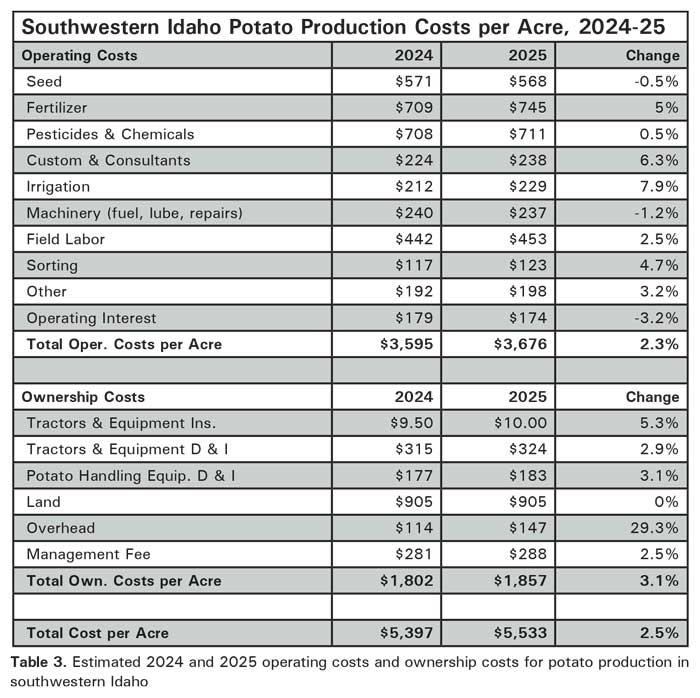
Though prices for some inputs could come down this year, overall production costs are expected to remain high for the 2026 crop. Table 3 shows the estimated 2024 and 2025 operating (direct/variable) costs and ownership (indirect/fixed) costs for potato production in southwestern Idaho. Per-acre operating costs rose by 2.3% in 2025. There were small cost reductions last year for seed, fuel and interest. On the other hand, fertilizer, chemical, irrigation and labor costs were up from 2024 levels. Currently, seed, fuel, chemical and fertilizer costs are down slightly, relative to year-earlier levels. Other operating expenses are expected to increase in 2026. Though H-2A wage rates are expected to come down, overall labor costs may be relatively flat. Relatively high interest rates could decline somewhat, but possibly not before operating loans are secured.
Ownership costs continued to increase for the 2025 crop. Overall, 2025 ownership costs rose 3.1% above 2024 costs, which put the total cost increase at 2.5%. Idaho’s cost per cwt was down slightly due to increased yields for the 2025 crop. Machinery and equipment depreciation has increased significantly during the past several years with rising equipment and interest costs. A shift to mechanical sorting due to rising labor costs and workforce availability has encouraged more investment in technology. Land rents continue to receive upward pressure as farmland values increase along with demand from other ag sectors. However, land rent and equipment costs could be relatively stable in 2026.
Other Factors
Several other factors could affect the 2026 U.S. potato acreage. Processing contract volumes in the Pacific Northwest are expected to be flat or down slightly. Carryover from the 2025 crop may reduce the need for early potatoes. Contract volumes could be stable in the Midwest and Northeastern processing states. Though global demand for French fries and other frozen potato products remains strong, competing with the European Union, China, India, Egypt, Argentina and other areas has been challenging for North American fryers. Crop rotation requirements typically prevent wide year-to-year swings in potato acreage. Shifts in acreage on a statewide basis are often more variable than the change in acreage on a national level. Year-to-year changes are typically less than 5%. Nevertheless, it will likely take a larger acreage reduction to turn markets around this year. Finally, the country’s overall economic and political conditions may also weigh heavily on planting decisions. Growers across the country are weighing the unique financial, production and market risks of growing potatoes this year.
Summary
There are several factors to consider when making planting decisions for the 2026 crop year. Open-market potato prices are currently less than one-fifth of the break-even price. Prices for most alternative crops are also down, but not as much. The opportunity cost of growing potatoes versus other crops will once again be at the forefront of this year’s planting decisions. Rising production costs and lower contract prices will continue to squeeze profit margins. Other factors such as contract volumes, irrigation water supplies, yield variation, crop rotations and global economic conditions will affect planting decisions this spring.