
Story and photos by Denise Keller, Editor
From the field to the lab, researchers are working to find ways to grow better potatoes. At the Oregon State University Potato Field Day, held June 24 in Hermiston, Oregon, researchers spoke about their latest efforts to improve pest management in potatoes and develop varieties with increased resistance to pests and diseases.
Volunteer Potatoes
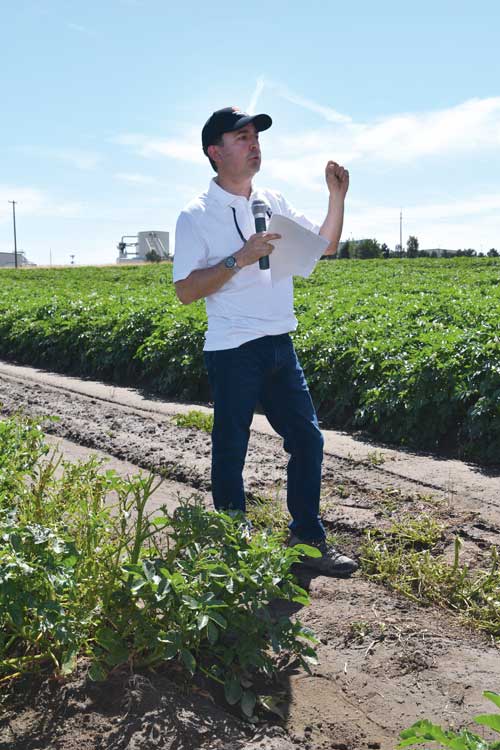
OSU plant pathologist Ken Frost and OSU entomologist Josephine Antwi are teaming up to study the role of volunteer potatoes in pest management.
Volunteer potatoes, which emerge from tubers left in the soil after harvest, act as weeds that compete with the current season crops for resources. While growers in the Columbia Basin have been dealing with volunteers for a long time, they’re becoming more problematic in the Midwest, Frost said. That’s because historically, cold winter temperatures have limited volunteer survival, but more recently, winters are becoming milder.
Frost and Antwi are interested in the role volunteer potatoes play as a green bridge for insects and pathogens between potato crops and how that contributes to the persistence of pests in the landscape. Previous work has shown that one day of soil temperatures around 27 degrees Fahrenheit keeps Russet Burbank tubers from coming up as volunteers, but there’s not much known about other cultivars. Frost will evaluate chill exposure for different varieties and how that relates to tubers re-sprouting the next year.
The researchers will also look at the prevalence of potential pests and diseases associated with volunteer potatoes including Colorado potato beetles, aphids, nematodes, Potato virus Y (PVY), late blight and powdery scab.
Their work aims to gain information that will help growers better manage volunteers or at least know where potato volunteer and associated pest risks are higher.
Variety Development
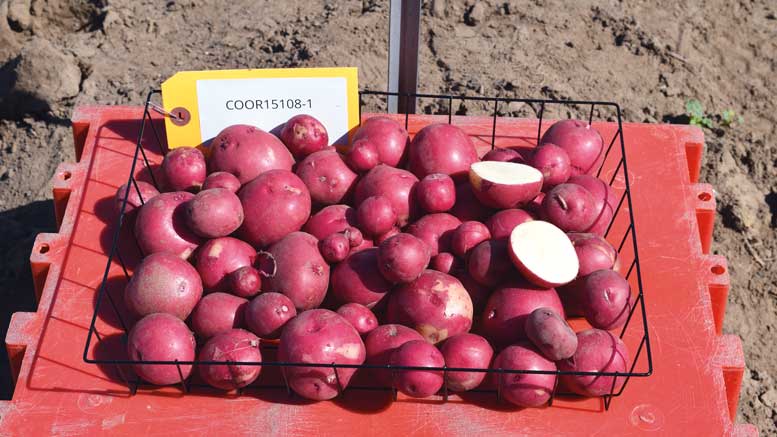
Field day attendees also heard about some of the latest selections from the Tri-State Potato Research and Breeding Program. OSU plant breeder Sagar Sathuvalli started his presentation with a description of Canyon Creek Russet, a processing variety shown to produce large tubers and yields similar to Ranger Russet and Clearwater Russet. It is resistant to PVY and cold sweetening and tolerant to common scab, but susceptible to late blight and Fusarium dry rot.
Vantage Russet is a high-yielding, late-maturing selection with oblong to long, slightly flat tubers. It has good processing quality, good gravities, high vitamin C and very high antioxidant activity levels. It is moderately resistant to Verticillium wilt and susceptible to PVY, common scab and late blight.
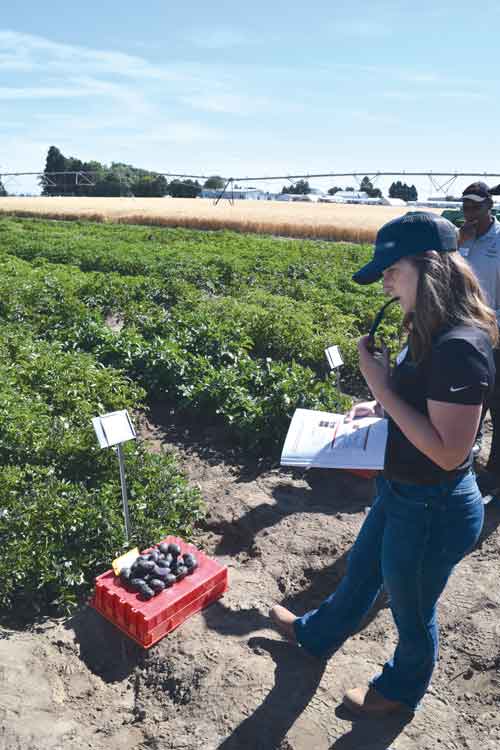
AOR13064-2 offers cold sweetening resistance, high processing merit and low acrylamide forming potential. It is resistant to early blight and common scab and tolerant to Fusarium dry rot. It yields similar to, but slightly lower than, Ranger Russet.
“From a post-harvest perspective, this is one of the best selections that we have in our program,” Sathuvalli said. “Its yield production is potentially slightly less than some of our major control varieties, but when you consider the pack-out and the processing percentage recovery, it’s on the very high side. So as a processor, you will not lose money. But for a grower, because of the tonnage, it might be less. But that is something that agronomists might be able to push to get more yield. That’s the only issue.”

Nematode Resistance
Marcella Teixeira, an OSU research associate, is part of a team working to develop potato varieties resistant to the three nematodes that are the biggest concern in the Columbia Basin: Columbia root-knot nematode, root lesion nematode and stubby root nematode.
“We want to bring you guys some tools that you can use in the field, not just basic research that we perform to understand something, but in a way that we can translate it to actual use,” Teixeira said.
Specifically, Teixeira is working to speed up the variety development process by using high-throughput assays designed to screen multiple clones for nematode resistance more quickly. For example, in as little as 10 days, a paper pouch assay can determine if nematodes can enter plant roots and start feeding. Clones with promising results can be further tested in sand cones to evaluate nematode reproduction in a month.
“Let’s just make mistakes faster so we can progress faster. That’s the idea,” Teixeira said. “Once we identify a gene from wild potatoes, we just want to confirm that’s indeed what’s conferring resistance to nematodes. We can do that faster without generating full transgenic plants, which would take a while. We can just make transgenic roots and screen them really fast.”