
By Ben Eborn, Publisher, North American Potato Market News
USDA reports that growers in the 13 reporting states planted 873,000 acres of potatoes in 2026. That is 29,000 acres fewer than they planted in 2025. It is the smallest U.S. planted area since 1952. Eight states reported a downturn in this year’s planted area. The reductions came in Idaho (-15,000 acres), North Dakota (-3,000 acres), Colorado (-2,000 acres), Michigan (-2,000 acres), Minnesota (-2,000 acres), Nebraska (-2,000 acres), Wisconsin (-2,000 acres) and California (-1,000 acres). No states reported an increase.
Reports from Canada show that growers planted 395,176 acres of potatoes this year. That is 1,946 acres fewer than they planted last year. It is Canada’s second largest planted area on record. Acreage in the Maritime Provinces dropped by 5,075 acres primarily due to contract reductions for frozen processing potatoes. In contrast, the planted area in the Prairie Provinces increased by 2,440 acres to meet the needs of the region’s growing processing sector.
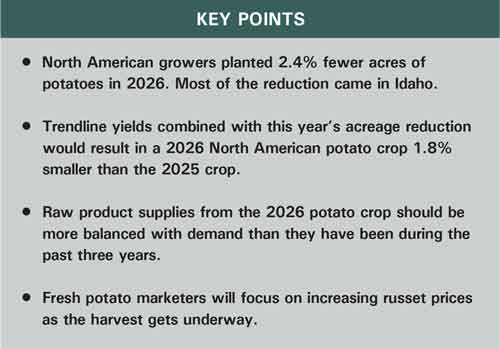
The combined North American potato area is 1.268 million acres, down 30,946 acres, or 2.4%, from the 2025 crop. It is the smallest planted area in at least 40 years. Over the past 10 years, Canadian potato acreage has expanded by 14.9%. On the other hand, U.S. potato acreage is down 10.9% relative to 2017 levels.
Abandonment
USDA projects this year’s harvested area at 867,600 acres. That is 29,200 fewer acres than growers harvested in 2025, a 3.3% reduction. A year ago, U.S. growers abandoned 5,200 acres of potatoes, 0.6% of the planted acreage. During the previous five years, abandonment has averaged 0.6% of the U.S. potato area.
Canadian growers abandoned 4,090 acres of potatoes during 2025. That was 1% of all potatoes planted. Abandonment averaged 1.7% during the previous five years. Because there have been only a few reports of abandonment so far this growing season, we have held our estimate of Canadian abandonment at 1.2%. Canada’s 2026 harvested area would be 390,275 acres.
Based on these harvested acreage estimates, the combined North American 2026 harvested acreage would be 1.258 million acres, down 2.5% from 2025 levels.
Yields and Potential Production
The U.S. long-term trend yield is 465 cwt per acre. That is up from the current estimate for the 2025 yield, 460 cwt per acre. Using the trend yield and projected abandonment, the U.S. would be expected to produce 398.6 million cwt of potatoes during 2026. That is only 14.3 million cwt, or 3.5%, less than 2025 production, and it is 4.6% below the five-year average.
Cananda’s average potato yield has increased by about 2.9 cwt per acre, per year for the past 10 years. The long-term trend yield for the 2026 crop is 332 cwt per acre. The current yield estimate for last year’s crop is 320 cwt per acre. With a trend yield and estimated abandonment, Canada would produce a 129.4 million cwt crop during 2026. That would exceed 2025 production by 3.5 million cwt or 2.8%.
North American potato production is expected to decline in 2026. Estimated abandonment and trend yields suggest that North America’s 2026 potato crop could total 528.9 million cwt. That is 1.8% less than 2025 production. However, it would be 13.8 million cwt, or 2.5%, below the five-year average production for the U.S. and Canada combined. Using trendline yields and average abandonment is a good place to start estimating total production. It only takes average growing conditions to produce a trendline yield. However, there are many other factors that can and will impact potato production between the time I write this article and the time you sit down to read it. And a lot can happen before harvest is complete.
Potatoes were planted on time, or slightly ahead of schedule, in several of the major U.S. production regions. In general, summer growing conditions have been favorable across the country. However, the prolonged heatwave and smoke from wildfires could affect yields and quality in the Pacific Northwest. In Canada, planting was delayed by cool, wet weather in several of the eastern provinces. Summer growing conditions, so far, have been variable but mostly favorable across the country. Considering these factors, North American potato production could fall short of trend yield projections.
Processing and Table Potato Supply Situation
Though there were acreage shifts between processors, the Columbia Basin’s total planted area is expected to be stable compared to last year. Idaho growers reduced acreage for dehy processing potatoes, while the planted area for frozen processing potatoes increased. Growers also planted fewer open-market table potatoes than they did last year. Planted area reports suggest that growers in most of the other processing states and provinces reduced their planted area, except for Maine and Alberta. Overall, Pacific Northwest growers planted 15,000 fewer acres of potatoes than they did in 2025. All this year’s acreage reduction is in Idaho. That acreage, combined with trendline yields, would result in a 2.3% downturn in PNW potato production. Demand for early varieties is up, as fryers are eager to run new-crop potatoes due to quality issues with the tail end of the 2025 crop. Reports suggest that yields and quality for early-harvested potatoes have been above average due to nearly ideal growing conditions, especially in the Pacific Northwest. Projected yields in the PNW and other processing regions will likely result in a 2026 raw-product supply that is more balanced with demand than it has been during the past three years.
Russet table potato production will likely be down in 2026. If USDA’s planted area estimates are correct, growers in several states planted fewer russets. In addition, yields are expected to be down in Idaho. The acreage reduction was driven by extremely low, unprofitable table potato prices for the 2025 crop. New varieties, yield increases and storage improvements continue to reduce the number of acres needed to meet current demand levels. At 300,000 acres, Idaho’s planted area combined with a trend yield would lower the state’s total production to 133.7 million cwt, which is 4.7 million cwt, or 3.3%, smaller than the 2025 crop. Canadian growers also appear to have reduced russet table potato acreage in 2026. Marketers are determined to increase prices during August and September as the harvest gets underway.