
By Kasia Duellman and Phillip Wharton, University of Idaho
Black dot has been gaining renewed attention among growers due to its potential impact on tuber quality and marketability. This blemish disease was once considered minor, but recent production pressures, consumer expectations for blemish‑free potatoes, and evolving soil health challenges appear to have played varying roles in elevating black dot into a mainstream management concern. Here’s what you need to know to identify and effectively manage this increasingly important disease.
What Is Black Dot?
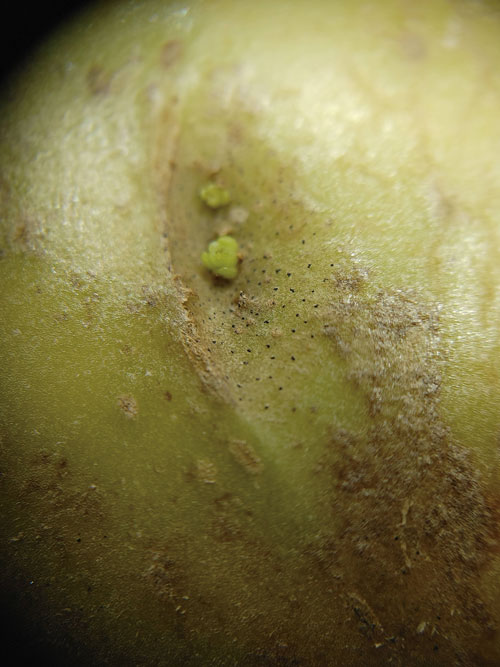
Black dot is a potato disease caused by the fungus Colletotrichum coccodes, a member of a group of pathogens well known for producing tiny dot‑like black microsclerotia on infected plant tissues. Those with good eyesight can see these tiny structures with their naked eye, and a good hand lens comes in handy for the rest of us. Although once considered a “weak pathogen” because it typically expresses symptoms only on senescing (aging) or heavily stressed plants, modern research has demonstrated that this pathogen is far from weak. In reality, C. coccodes can independently cause severe root rot, premature vine death and yield reductions up to 30%. It is also a frequent secondary contributor to the Potato Early Dying (PED) complex, exacerbating the damage caused by Verticillium dahliae and root-lesion nematodes.
Microsclerotia can survive in a dormant state for more than five years in the soil. These soilborne structures are considered the most important source of primary inoculum. Infected seed tubers are another source of primary inoculum, and this avenue becomes important when planting into a clean field.
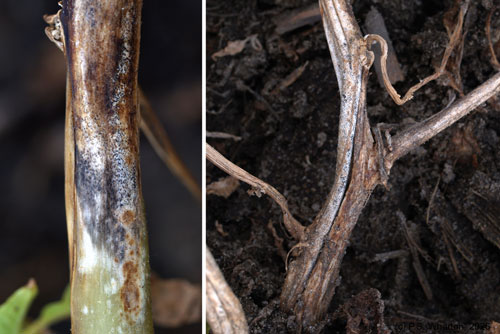
The pathogen is highly elusive with a hemibiotrophic lifecycle. It typically infects potato roots, stolons and stems very early in the growing season, but plants remain completely asymptomatic while they are actively growing. The pathogen latently occupies the living host tissue and only transitions to a destructive, necrotrophic phase when the plant naturally starts to senesce or die, at which point the fungus rapidly produces its characteristic black microsclerotia. Foliar symptoms start as pinpoint lesions that can expand into lesions on stems. Microsclerotia form on stems, stolons and roots and are especially visible after vine kill. The density of microsclerotia can be so great that the affected areas can look entirely black.
-AMAZONPOLLY-ONLYWORDS-START-
-AMAZONPOLLY-ONLYWORDS-END-
Tuber Symptoms
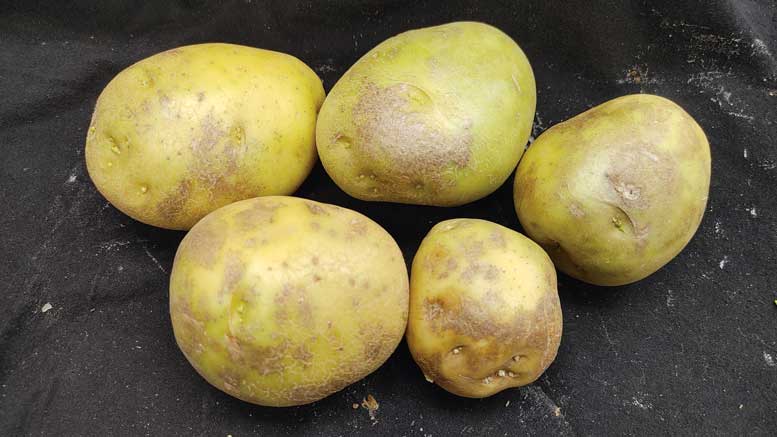
Tuber symptoms include light brown to gray discolored patches on the tuber surface, sometimes covering large areas. The stolon of the tuber may still be attached, and a magenta discoloration might be visible at the point of attachment when black dot is present. The tuber blemishes are more visible when tubers are wet. These symptoms are particularly visible on light-skinned varieties, but all types of potato can be affected.
Symptoms of black dot are often confused with silver scurf, another tuber blemish disease, and tubers can have both diseases. Distinguishing these blemish diseases can be difficult if microsclerotia or other fungal structures have not yet formed. Laboratory tests might be needed to confirm presence of the pathogens.
Secondary infections of black dot do not occur in storage since the pathogen is not able to infect tubers after skin set has occurred. Thus, all infections found in storage occurred in the field. Symptoms on tubers infected in the field develop in storage, giving the illusion of spread to healthy tubers. Black dot differs from silver scurf, which can readily spread from infected to healthy tubers via airborne spores in storage.
Though black dot blemishes don’t lead to secondary infections or other rots in storage, the disease can seriously reduce cosmetic quality, which is an increasing concern for the fresh-prepack market. The disease can also predispose tubers in storage to an increased rate of dehydration since symptoms can breach the skin. Severe cases may also lead to rejections of potatoes destined for processing since peeling may be more difficult.
Why Black Dot Is Becoming More Problematic
Black dot is becoming more problematic in potato production because market expectations and disease management limitations have increased its economic importance. Fresh market buyers and consumers increasingly demand potatoes with clean, blemish-free skins, and the silvery to brown lesions caused by black dot can make tubers unmarketable even when yield losses are limited. In regions with abundant potato production, this has likely increased grading pressure and buyer selectivity, making black dot a more frequent cause of rejection and economic loss. At the same time, the pathogen can survive in soil for several years, reducing the effectiveness of crop rotation, and no resistant potato varieties are currently available.
Management challenges have also contributed to the growing importance of this disease. Previous fungicide programs often emphasized applications beginning at row closure and targeted symptoms that appeared late in the season, which contributed to the view that fungicides were ineffective for reducing black dot on tubers in storage. More recent University of Idaho research has shown that earlier applications, particularly when plants are 6 to 8 inches tall with or without an in-furrow fungicide application, can reduce black dot development on tubers during storage. Since no postharvest fungicides can stop symptom development on tubers that were infected in the field, effective management depends largely on timely in-season protection.
-AMAZONPOLLY-ONLYWORDS-START-
-AMAZONPOLLY-ONLYWORDS-END-
Current Management Strategies
Management of black dot begins with planting certified, high-quality seed. When possible, avoid planting into fields with a history of black dot, and do not plant seed lots that show visible symptoms. Research has shown a strong relationship between the amount of black dot inoculum present in soil before planting and the amount of disease that later develops on tubers in storage. Soil testing can therefore be useful for estimating risk before planting. The University of Idaho Diagnostic Laboratory at the Parma Research and Extension Center can test soil for the black dot pathogen and provide an estimate of disease risk.
University of Idaho field trials have shown that the most effective fungicide programs are those applied early, when plants are 6 to 8 inches tall with or without an in-furrow fungicide application. Strobilurin and SDHI fungicides both reduced black dot in storage, and application timing appeared to be more important than the specific product used. Other studies have also shown that limiting the growing season to about 110 days or fewer, measured from 50% emergence to harvest including vine kill, can significantly reduce black dot on tubers in storage without reducing yield. Soil fumigation with chloropicrin may also help lower disease pressure. After harvest, if tubers are suspected to carry high levels of black dot infection, marketing them early may help reduce losses because tubers infected in the field can continue to develop visible symptoms during storage.
What’s in Store for the Future of Black Dot Management?
Better black dot management tools may be developed in the future, as we develop new varieties with enhanced disease resistance, improve models that link soil inoculum levels with risk, clarify impact of environmental factors, identify and harness the influence of the soil microbiome, and develop integrated models that combine soil inoculum, cultural practices, fungicide timing, variety selection, storage management and other factors.
Meanwhile, if you are managing a potato field with a history of black dot, keep this disease on your radar and implement proactive strategies such as early-season foliar applications of an effective fungicide labeled for control of black dot and reduce season length to fewer than 110 days.