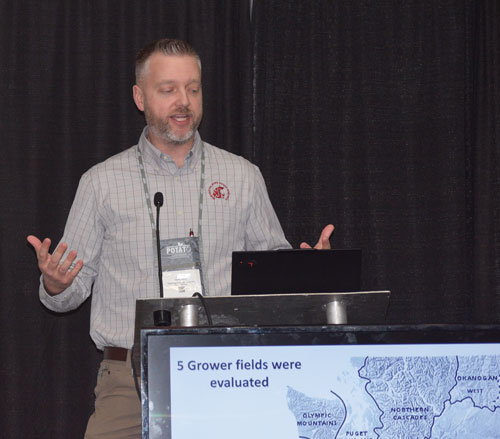
For many farmers, weather can be the source of some of the greatest challenges each season. But weather trends in the Columbia Basin show Mother Nature might be providing an opportunity for growers, as well, in the form of early springs and delayed autumns. Mark Pavek, a potato specialist at Washington State University, discussed ways to capitalize on a longer potato growing season in his presentation at the Washington-Oregon Potato Conference, held Jan. 27-29 in Kennewick, Washington.
-AMAZONPOLLY-ONLYWORDS-START-
-AMAZONPOLLY-ONLYWORDS-END-
Pavek set the stage for his talk by sharing some statistics based on weather in Pasco, Washington, from 1895 through 2025:
- Earliest day with temperature over 80 degrees Fahrenheit: March 19, 2024
- Latest day with temperature over 90 degrees: Oct. 6, 2020
- Most days in a year with temperature over 100 degrees: 27 days in 2022
- Most days in a year with temperature over 110 degrees: 5 days in 2021
- Consecutive days over 80 degrees: 89 days in 2017
- Consecutive days over 100 degrees: 11 days in 2022
- Consecutive days over 110 degrees: 5 days in 2021
-AMAZONPOLLY-ONLYWORDS-START-
-AMAZONPOLLY-ONLYWORDS-END-
“The average trend is our low and high temperatures are going up steadily over time,” Pavek said. “What that is doing to us is it’s increasing the length of our growing season.”
Since 1960, the potato growing season in the western U.S., on average, has increased by 15 days. The moral of the story is to plant earlier and harvest later, Pavek said, but added that there’s more to the story.
-AMAZONPOLLY-ONLYWORDS-START-

-AMAZONPOLLY-ONLYWORDS-END-
“Heat during the wrong time of year can really cause you some problems,” Pavek said.
Late-season heat in August and September tends to be harsher on the crop and can create issues as potatoes move into storage. When looking at the potatoes grown in the annual WSU variety trial, a correlation can be seen between the hottest years and the years with lower yields of U.S. No. 1 Russet Burbanks. On the other hand, growers can capitalize on heat that arrives in the spring and turn it into plant growth.
“On the tail-end of the front end, we have some opportunities. Warming during the colder fringes – spring and fall – is beneficial to growth of healthy plants. To capture the benefits of longer seasons, syncing our cultural management with accelerated plant growth can really add up,” Pavek said.
-AMAZONPOLLY-ONLYWORDS-START-

in Washington.
-AMAZONPOLLY-ONLYWORDS-END-
Pavek outlined several ways that growers can make the most of the longer growing seasons now and in the future. When above-average temperatures are forecasted to hit during and following plant emergence, growers should anticipate rapid vine growth and prime plants with nutrients and soil moisture. Adequate pre-plant fertilizer is essential to capture growth during early-season heat, Pavek said. As the season continues, growers should maintain soil moisture during rapid growth, build a large canopy early and let it mature slowly. Adjust nitrogen applications to begin earlier and taper as plant water demand declines to allow plants to naturally senesce.
Looking at longer-term considerations, Pavek said new potato varieties might be the best way to deal with late-season heat to prevent tuber quality issues in and out of storage. In addition, it would be smart for the industry to focus on varieties that take advantage of a longer growing season with vines that stay healthy until growers want them to senesce, he said.
-AMAZONPOLLY-ONLYWORDS-START-

-AMAZONPOLLY-ONLYWORDS-END-