
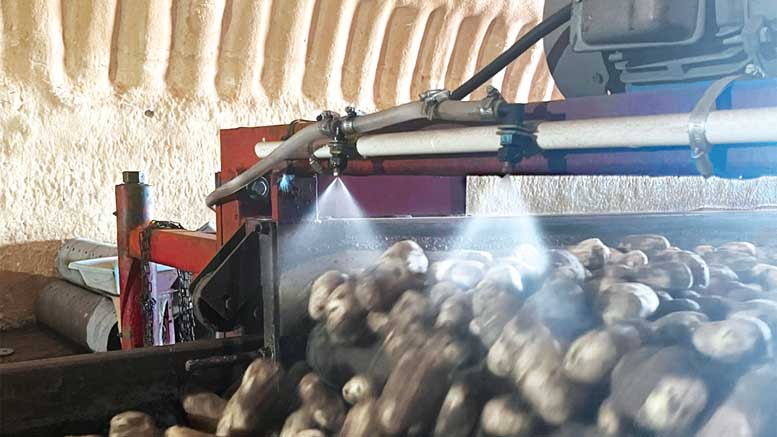
By John Klimes, Product Quality Specialist, Agri-Stor Companies
It’s that time again; potato storages are filled with the new crop and the storage has been brought down to the correct temperature. Application technicians have applied sprout inhibitors (suppressants), and storage managers or growers finally feel at peace for the storage year… or do they?
Consider this: what happens if the sprout inhibitor stops working around the first of the year? Even though storages are being monitored regularly, a thought that could still weigh heavy on the mind is “Are my potatoes waking up? Why?” Several factors are involved in determining sprout suppressant longevity such as crop variety characteristics, holding temperature and free moisture in the storage. Other important factors relate to the actual sprout inhibitor product(s): which products were applied, how much was applied, when they were applied, and how thorough the application was. There are a few other factors involved, but the aforementioned are the easiest to control.
Variety characteristics are probably the number one factor in dormancy and successful sprout suppression. This is beyond growers’ control for the most part, as a contract or certain desirable characteristics may dictate the variety that is grown. Knowing the variety characteristics is very important. For example, a short-dormancy variety requires more suppressant to be applied earlier for the same storage duration as other varieties. After natural dormancy breaks, many other factors come into play.
Once natural dormancy has been lost, a sprout suppressant needs to be applied. The most common on the market currently is CIPC, but there are others available, as well, with variable efficacy. Depending on the storage season goals, different rates can be applied for each product, and some can also be used in combination, providing a synergistic or compounded efficacy. How long the suppression lasts depends on a few variables, but ultimately the amount of suppressant applied will determine how long it will last at the desired holding temperature. These rates are provided on each product label and are usually based on storage temperature and how long the product is going to be stored. Warmer temperatures in storage will encourage potatoes to sprout earlier, so a greater amount of suppressant would need to be applied.
Failure of sprout suppression can be tied to a few variables which the grower does have the ability to control. First, an understanding of the sprout suppressant product label is a necessity. Ensure enough product is applied to store the potatoes for the amount of time and at the desired temperature. Know what a good application looks like. Excess dirt in the pile and settling can restrict airflow, which can have a negative effect on a good application. Damaged ducts can also restrict airflow if the holes are squashed down into the dirt. Balanced air movement is essential for a good application. A well-planned and properly executed application of sprout suppressants should last for the entire storage season – provided the following two points of control are managed properly.