

Nearly two decades after a quarantine pest of potatoes known as pale cyst nematode (PCN) was first discovered in Eastern Idaho, officials have confirmed their first success in eliminating it from a once-infested farm field.
Having passed the rigorous testing requirements of a federally funded PCN eradication program, a 118-acre field belonging to Shelley farmer and Idaho Farm Bureau Federation President Bryan Searle has been deregulated and is once again eligible for potato production.
Searle attributes the positive outcome in part to the efforts of University of Idaho agricultural researchers, led by Louise-Marie Dandurand, a professor in the Department of Entomology, Plant Pathology and Nematology and director of U of I’s PCN Project.
“Researchers at University of Idaho played a big role in helping us arrive at this monumental moment. We worked hand in hand with them on this issue, and they played a pivotal role in helping find a solution,” Searle said. “They are the experts and the ones who have done the research necessary to say we need to try this and this. Their role in all of this is greatly appreciated.”
PCN are microscopic, cyst-forming roundworms that can damage certain crops. Females form cysts that can hold up to 600 eggs, which can be dormant for more than three decades while remaining viable.
-AMAZONPOLLY-ONLYWORDS-START-
-AMAZONPOLLY-ONLYWORDS-END-
U of I nematologist Saad Hafez, who retired as a professor in October 2024, discovered PCN in 2006 while testing the loose dirt in a truck hauling potatoes from a field in the Shelley area to a packing shed. After thorough testing of associated fields in the area, the U.S. Department of Agriculture’s Animal and Plant Health Inspection Service contained PCN to an 8.5-mile radius in eastern Idaho. It remains the sole location in the U.S. where the pest has been confirmed, though officials in New York have been battling a close cousin of PCN, golden nematode, since 1941.
In a 2016 study, “Economic Impact of Globodera Pallida on the Idaho Economy,” U of I researchers, Chris McIntosh, Phil Watson, Samjhana Koirala and Dandurand estimated the annual economic impact of PCN on the Idaho economy, including indirect and induced effects, at $30.38 million.
In addition to concerns about potential production losses, containing and eradicating PCN is crucial for protecting trade markets for Idaho’s famous potatoes.
Currently, 6,315 acres are regulated under the PCN program – including 3,420 acres that are considered infested and 2,895 acres that are regulated due to associations with infested fields.
To be deregulated, an infested field must pass through three steps. The first step entails confirming that no eggs in any cysts sampled from the field contain viable eggs. Unlike living cysts, dead cysts will absorb a fluorescent stain and glow green in testing.
Dandurand’s laboratory conducts the second test, which entails raising potted potato plants with soil harboring cysts supplied by APHIS. The greenhouse test takes 16 weeks to complete and is repeated three times over a year and a half to confirm that no cysts are stimulated to reproduce.
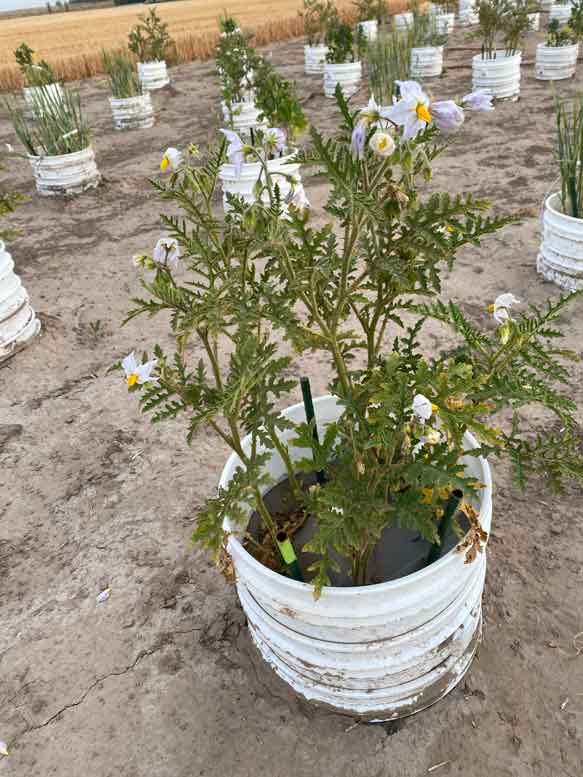
The third test is conducted in the field, where the farmer must raise three seasons of crops planted in a susceptible potato variety, followed by testing to confirm no cysts with viable eggs have surfaced.
“Our regulatory program is extremely stringent and it’s very hard to get through. That grower has been out of production for 19 years and can finally get back into production,” Dandurand said of Searle’s accomplishment. “For that grower it’s an incredible achievement to regain access to that land.”