By Alexander Karasev and Nora Olsen, University of Idaho
Research at the University of Idaho is helping potato breeders make progress in their efforts to breed potatoes with resistance to all strains of Potato virus Y (PVY).
PVY is a serious problem limiting profitable production of seed potato and affecting yield and tuber quality in commercial potatoes. Robust cultural management programs are used by seed growers to minimize the level of PVY in seed potatoes, but PVY remains a challenge due to the biological nature of PVY infection and spread by aphids. Breeding and introgression of various types of PVY resistance in commercially available potato cultivars is the most effective strategy to manage the virus in the long run. Nevertheless, the use of genetic resistance to PVY is still relatively limited in the potato industry, which continues to rely on virus control through seed certification and control of aphid vectors with mineral oil sprays and insecticides.
One of the main reasons PVY is so difficult to manage in potato is the existence of multiple distinct strains of the virus, which helps the virus overcome traditional control measures. For a long time, potato breeding programs unknowingly relied on strain-specific resistance genes common in commercial potato cultivars. For example, the cultivar may be highly resistant to the ordinary strain of the virus, PVYO, which was the dominant virus in the past. These new potato cultivars carrying strain-specific resistance, in this case placed PVYO under pressure and eventually PVYO disappeared from potato fields in the Pacific Northwest.
A new problem was created: the displaced PVYO strain was immediately replaced with other strains of the virus, primarily by the recombinant PVYNTN and PVYN-Wi, and unfortunately, the potato variety was only resistant to PVYO (conferred by Ny genes) and not these recombinants. Conceivably, the approach of relying on strain-specific resistance favors the selection of PVY strains overcoming Ny-gene resistance and additionally causing inconspicuous symptoms; hence, instead of limiting PVY spread, it would shift the virus strain composition in the field. An unintended consequence is the preferential selection of strains like PVYNTN, which induce mild symptoms in the foliage of many potato cultivars, but can cause tuber necrotic symptoms in susceptible cultivars such as Yukon Gold.
-AMAZONPOLLY-ONLYWORDS-START-
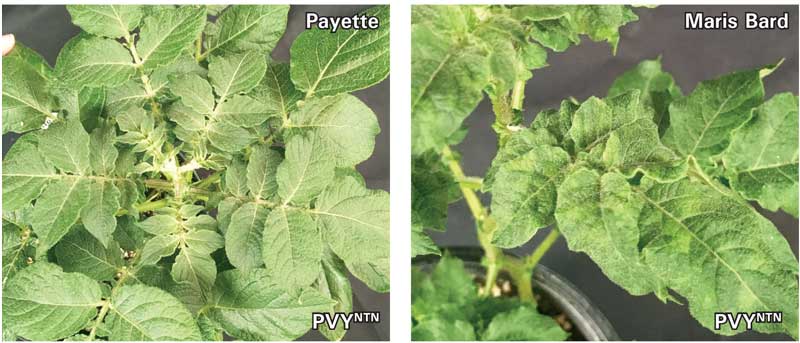
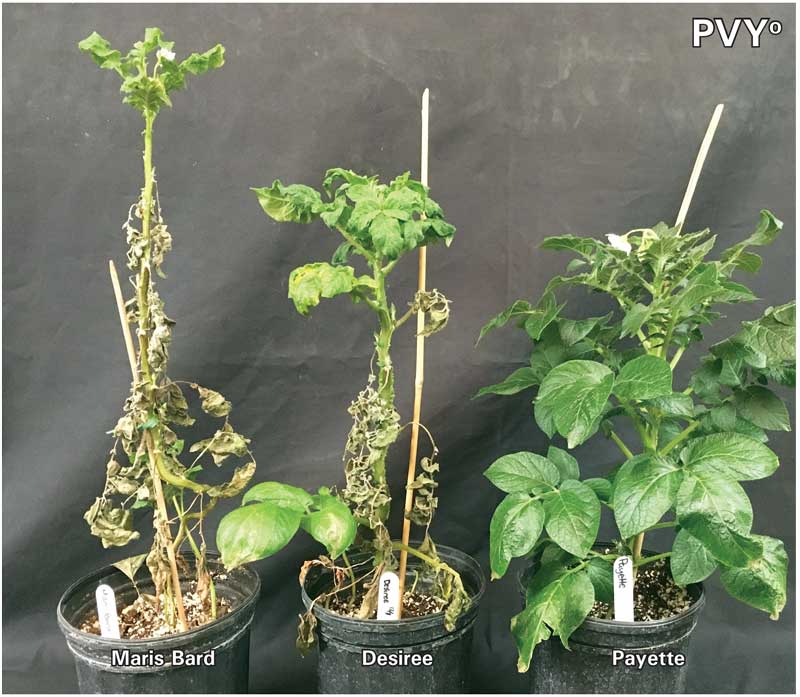
Potato cultivars are five weeks post-inoculation with two strains of PVY: PVYNTN and PVYO. Payette Russet looks healthy and remains uninfected, as confirmed by laboratory tests.
-AMAZONPOLLY-ONLYWORDS-END-
Nowadays, potato breeding programs place the focus of PVY resistance breeding on a different type of genes, called Ry genes, conferring extreme resistance or immunity to all strains of PVY in potato. Ry genes were found in wild relatives of potato and are now being used in commercial cultivars such as Payette Russet and Castle Russet. To speed up the breeding process, breeders use molecular markers to follow specific genes in the progeny in crosses of prospective parental lines. Using molecular markers, a breeder can identify if a potential cross or numbered line has resistance to PVY. The crucial question comes at the end: how can you be sure that the potato line carrying the marker for an Ry gene is resistant to all strains of PVY? It is important to challenge and validate prospective PVY-resistant cultivars with a comprehensive range of PVY strains held in laboratory virus collections.
As part of the federally funded Specialty Crop Research Initiative (SCRI) project “Potato Virus Initiative: Developing Solutions,” we experimentally addressed this question about strain specificity of the Ry gene in potato cultivars such as Payette Russet and Castle Russet. The tool used for these experiments is a large collection of more than 18 different PVY strains and genetic variants maintained in the Virology Laboratory at the University of Idaho. The entire genetic diversity of PVY strains ever found in the United States is represented in this collection. Several of the virus strains are from outside of the U.S. and some are from non-potato hosts.
For instance, under greenhouse conditions, Payette Russet is completely immune to PVY isolates representing 18 different strains and genetic variants, including all found in North America. As a control or comparison, potato cultivars with only strain-specific resistance conferred by Ny genes, or no resistance at all, could easily be infected with the PVY strains. In these experiments, we confirmed that the Rysto resistance gene available in the Payette Russet genome confers broad and robust protection against all the PVY strains from the University of Idaho collection. Hence, the exciting news is that the potato cultivar Payette Russet is a valuable parent for further breeding of PVY-resistant cultivars. Consistent use of Ry resistance genes with broad and robust specificity is considered as a new and promising control strategy for PVY in potato. Stay tuned for more variety releases to be resistant to PVY as the breeding programs continue to utilize the Ry genes for “universal” PVY resistance.
For more information on the “Potato Virus Initiative: Developing Solutions” project and the various research and activities of the grant, visit www.uidaho.edu/cals/potato-virus-initiative.