By Aritra Roy Choudhury, Montana Seed Potato Certification
Seed potato certification is built on trust – trust in the system, trust in the data and, ultimately, trust in the seed. As new technologies emerge, it is our responsibility not just to adopt them, but to evaluate where they fit and how they strengthen that trust. Direct tuber testing (DTT) is one such technology that is gaining momentum across the United States, and while it holds tremendous promise, it must be viewed in the right context.
Across certification programs, there is growing interest in integrating DTT into routine testing workflows. The certification agencies across the states are working collaboratively to standardize protocols, validate results, and ensure that data generated in one program is meaningful and comparable across others. This level of coordination is encouraging and necessary as we move toward a more unified national framework.
However, as we adopt new tools, it is equally important to remain grounded in what has consistently worked.
Certification Is a Three-Legged Stool
Seed potato certification is not defined by a single test or a single season. It is a system that relies on multiple layers of evaluation to provide a complete picture of seed health. In my view, certification is a three-legged stool: summer field inspections, winter grow-out and direct tuber testing. Each of these components plays a significant and non-redundant role in making informed decisions.
Remove one leg, and the system becomes unstable.
Summer inspections provide the first line of defense, allowing us to evaluate disease expression, varietal purity and overall field conditions during the growing season. The winter grow-out in Hawaii has long served as the cornerstone of post-harvest evaluation. At present, DTT is entering the picture as a powerful diagnostic tool.
What DTT Does Well and What It Does Not
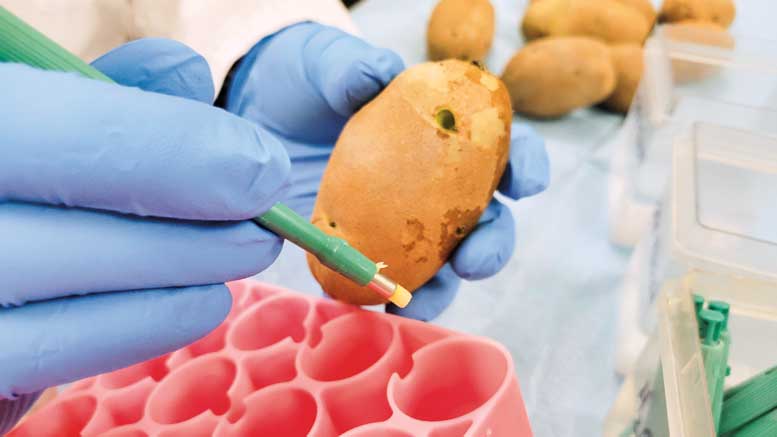
Direct tuber testing brings precision and sensitivity, particularly in detecting <<<Potato virus Y>>> (PVY). Its ability to identify infections directly from dormant tubers using molecular methods provides an advantage in detecting latent or low-level infections that may not be visually apparent.
But we must be clear about its current limitations.
At present, DTT programs are largely focused on PVY detection. While that is critically important, it represents only one part of the seed health equation. DTT does not capture varietal mixtures. It does not reveal chemical or physiological damage. It does not provide insight into field performance. And it does not adequately address other pathogens of concern, such as soft rot bacteria like <<<Pectobacterium>>> and <<<Dickeya,>>> which continue to challenge production systems.
The winter grow-out, on the other hand, provides a much broader lens. It allows us to see how plants emerge, how symptoms develop and how a seed lot behaves under field conditions. These observations are not easily replaced by molecular diagnostics.
A Coordinated National Effort
One of the most positive aspects of DTT adoption is the level of collaboration among states. The certification agencies are not working in silos but are actively coordinating sampling strategies, testing protocols and validation studies. This is exactly how new technology should be introduced: carefully, collectively and with a commitment to scientific rigor.
Multi-state validation trials, where seed lots are subjected to both DTT and winter grow-outs, help us understand how these systems align and where gaps remain. These efforts are critical, not only for validating DTT but also for defining how it should be used within certification standards. Encouragingly, most programs are not rushing to replace existing methods. Instead, they are building a hybrid system that leverages the strengths of each approach.
High-Throughput Testing: Opportunity and Reality
There is also a strong push toward high-throughput testing platforms to accommodate the growing demand for DTT. Automation, real-time PCR systems and expanded laboratory capacity are all part of this transition.
However, we must acknowledge a practical reality: increased demand is already testing the limits of current infrastructure.
Growers are submitting more samples than ever before, and while this reflects confidence in the system, it is also leading to longer turnaround times. In some cases, the expected speed advantage of DTT is being diminished by the sheer volume of samples being processed.
Direct tuber testing is here to stay, and it will play an increasingly important role in seed potato certification. But as we embrace this new technology, we must do so with clarity and caution. Certification is not about speed alone. It is about confidence. And confidence comes from using the right tools, in the right way, at the right time.