

|
Click to listen to this article
|
By Ben Eborn, Publisher, North American Potato Market News
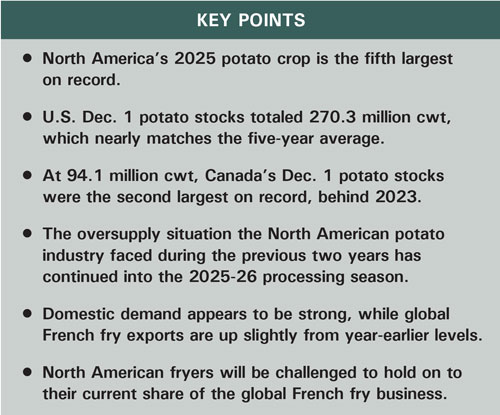
U.S. and Canadian growers produced 537.9 million cwt of potatoes during 2025. That is 10.3 million cwt, or 1.9%, less than 2024 production. The U.S. potato crop accounted for 88.4% of the reduction. U.S. production is estimated to be down 2.2% from the 2024 crop. Canada’s 2025 crop is estimated to be 0.9% smaller than the 2024 crop.
Dec. 1 stocks data, for both the U.S. and Canada, highlight several challenges and opportunities for the potato industry during the remainder of the storage season. In this article, we provide a brief outline of the raw-product supply situation for the North American frozen processing industry.
US Supply Situation
USDA estimates that potato growers produced 412.1 million cwt of potatoes during 2025. That is 9.1 million cwt less than the 2024 crop. It is 1.7% below the five-year average production. Growers in the storage states held 270.3 million cwt of potatoes on Dec. 1. That is 4 million cwt less than those states had in storage a year earlier, a 1.5% reduction.
USDA put Idaho’s 2025 potato crop at 138.4 million cwt. That is 3.1 million cwt, or 2.3%, more than 2024 production. Idaho’s Dec. 1 potato stocks totaled 95 million cwt, 1 million cwt, or 1.1%, more than the year-earlier inventory. Idaho processors used 25.7 million cwt of potatoes from the 2025 crop prior to Dec. 1, only 35,000 cwt more than they used from the 2024 crop during the same period.
USDA reports that Washington growers produced 88.6 million cwt of potatoes in 2025. That is 10.3 million cwt less than the state produced in 2024, down 10.4%. Dec. 1 potato stocks totaled 52 million cwt, according to USDA. That is 8 million cwt less than year-earlier holdings, a 13.3% reduction. It is Washington’s second lowest Dec. 1 inventory since 2008, matching December 2021 stocks. USDA reports that processors used 21.9 million cwt of new-crop potatoes prior to Dec. 1. That is 1.5 million cwt less than they used during the same timeframe a year ago.
Oregon’s 2025 potato crop totaled 26 million cwt, which is 134,000 cwt, or 0.5%, less than the 2024 crop. At 20.5 million cwt, Oregon’s Dec. 1 potato stocks are up 500,000 cwt, or 2.5%, from year-earlier holdings. USDA reports that early-season processing use totaled 13.2 million cwt. That is 400,000 cwt more than year-earlier usage, a 3.1% increase.
Dec. 1 stocks in the other processing states are mixed. At 19.3 million cwt, Wisconsin’s reported Dec. 1 potato stocks exceeded the year-earlier inventory by 1.8 million cwt, or 10.3%. North Dakota had 17.9 million cwt of potatoes in storage on Dec. 1, 1.6% less than it held in 2024. At 12.7 million cwt, Maine had 4.5% fewer potatoes in storage than the year-earlier inventory. Minnesota had 11 million cwt of potatoes left in storage on Dec. 1, down 7.6% from the previous year.
NAPMN estimates that U.S. processors used 65.5 million cwt of potatoes from the 2025 potato crop for purposes other than dehydration (mostly French fry production) prior to Dec. 1. That is 1 million cwt less than the 2024 usage rate, a 1.5% decline. It follows an estimated 1.1% increase for late-season usage from the 2024 crop. Total June-November usage in this category is estimated at 94.5 million cwt. That is 693,000 cwt, or 0.7%, less than June-November 2024 estimated usage. If the stocks data are correct, total Dec. 1 stocks in the Pacific Northwest are down only 3.7% from a year earlier. That leaves more than enough potatoes to run PNW plants at planned levels. Fryers in the Midwest and Maine also have access to an adequate supply of raw product. Reports indicate that some processors have reduced production significantly, while others have picked up some of the business.
Canadian Supply Situation
Canada’s 2025 potato crop is the third largest on record, behind 2023 and 2024. Canadian growers produced 125.8 million cwt of potatoes in 2025. That fell 1.2 million cwt short of the 2024 crop. The country had 94.1 million cwt of potatoes in storage on Dec. 1. That exceeded year-earlier holdings by 1.1 million cwt, or 1.2%. The Dec. 1 inventory is 8% larger than the five-year average supply. Stocks are up from last year in Alberta and British Columbia, but they are down in the Maritime Provinces, Quebec, Ontario and Manitoba. Processing potato supplies are up 0.6% from December 2024 holdings.
At 28.9 million cwt, Alberta’s Dec. 1 potato stocks exceeded the 2024 inventory by 5.8 million cwt, or 25.4%. Intended use data show that the province’s processing potato stocks are up 3.8 million cwt, or 20.8%, to a record 21.8 million cwt. The province’s processing capacity has expanded significantly during the past several years. Manitoba had 18 million cwt of potatoes in storage on Dec. 1. That is 10.4% less than the 2024 inventory. It included 14.6 million cwt of processing potatoes, down 1.8 million cwt from last year’s inventory. Quebec’s Dec. 1 potato stocks fell 6% below year-earlier holdings to 9.5 million cwt. At 3.7 million cwt, processing potato stocks are down 305,000 cwt from last year. New Brunswick had 12.2 million cwt of potatoes left in storage on Dec. 1. That nearly matched the year-earlier holdings. At 8.2 million cwt, processing potato stocks are up 168,000 cwt from the 2024 inventory. That leaves New Brunswick with its second largest Dec. 1 processing potato inventory on record.
Prince Edward Island (PEI) held 18.3 million cwt of potatoes in storage on Dec. 1. That is 10.2% less than year-earlier holdings. The late-summer drought took a toll on yields. At 11.4 million cwt, PEI’s Dec. 1 processing potato stocks fell 1.3 million cwt below the December 2024 inventory. That is the lowest Dec. 1 processing potato inventory since 2020.
The four major French fry producing provinces held 55.6 million cwt of processing potatoes on Dec. 1. That is 839,000 cwt more than the year-earlier inventory, a 1.5% increase. Most of the increased supplies are in Alberta, while raw-product supplies are also up slightly in New Brunswick. Processing potato stocks in PEI and Manitoba are down significantly relative to year-earlier inventories. Overall, Canada has an abundant supply of raw product from the 2025 crop, though supplies have been shipped to PEI to cover the island’s supply gap.
Conclusion
The oversupply situation the North American potato industry faced during the past two years has continued into the 2025-26 processing season. Domestic demand for French fries and other frozen products appears to be strong. Industry data indicate that buyers purchased 1.3% more U.S. frozen product between June and November than they did during the same period in 2024.
In addition, global French fry exports are up 0.2% for the year ending Sept. 30, 2025 (October data are not yet available due to the government shutdown). The U.S. exported 298.2 million pounds of French fries and other frozen products during August and September 2025. That is 12.6% less than year-earlier shipments.
On the other hand, Canada’s August-September French fry exports totaled a record 503.1 million pounds, up 0.8% from year-earlier movement. Shipments to the U.S. were down 3.7%, though total sales to offshore markets jumped by 33.5% during the period. Most of Canada’s extra shipments have gone to Mexico, up 89.1% from a year earlier. Canada may continue to ramp up the export pace during the remainder of the season.
Despite the current raw-product supply situation, North American fryers will be challenged to hold on to their current share of the global French fry business. Europe’s offshore exports could expand significantly with the 2025 potato crop, which is 10.4% larger than the 2024 crop. North American fryers will also face stiff competition from China, India, Egypt and Argentina this year.