|
Click to listen to this article
|
Story and photos by Bill Schaefer
Updates on the state of the potato economy globally, nationally and in Idaho were on the agenda at the Idaho Potato Commission’s 2025 harvest meeting. With an estimated 200 people attending the half-day session on Nov. 12, discussion topics included access to foreign markets, a reduction in regulations by the Idaho State Department of Agriculture, global growth by Asian potato producers and efforts by the IPC to efficiently promote Idaho potatoes.
National Potato Council
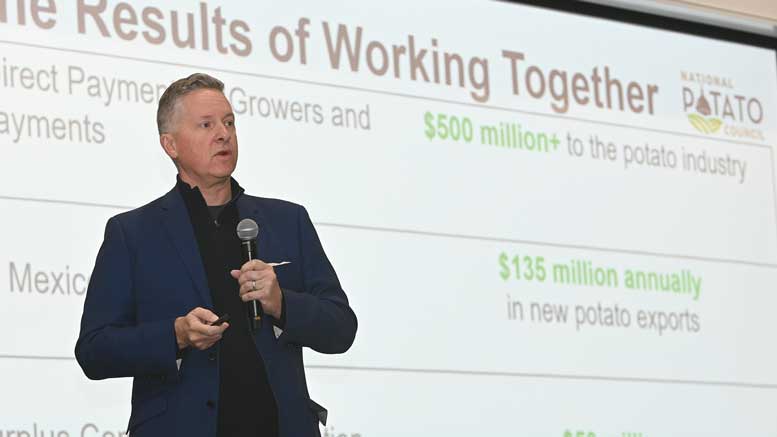
Kam Quarles, CEO of the National Potato Council, opened the meeting discussing the importance of protecting the development and growth of the market in Mexico and ongoing efforts to open Japan to the importation of fresh potatoes.
“In order to keep Mexico open, because it’s so important, we actually have a team working in Mexico, legal and regulatory experts,” Quarles said.
“One other market we’re working really hard on is Japan, and Secretary Rollins (USDA Sec. Brooke Rollins) made this statement to a group of producers a few months ago that she was going to go into Japan guns-a-blazing to get fresh potato access. So, you can’t ask for more commitment than that,” he said.
Quarles said that the Trump Administration has to keep the pressure on Japan to open the country to U.S. fresh potatoes.
“We have been fighting this battle for 30 years and they (Trump Administration) have the ability to bring this to a close,” Quarles said.
“The Japanese, their strategy is very clear. They want to negotiate with us, but they don’t want those negotiations to ever conclude. That protects the market. If you never get to the finish line, their market remains closed to us,” he said.
Idaho State Department of Agriculture

Chanel Tewalt, Idaho State Department of Agriculture director, followed Quarles’ presentation with an emphasis on what she called “hyper-local” issues concerning pesticide and chemigation use and application in Idaho.
“If you, for some reason, have had anything but a great experience with that, come and tell me,” she said about chemigation reforms put in place this past year, “because it should be so much easier. If we come to your farm, we perform an inspection, you get a license. You don’t have to take a test; you don’t have to go through any of these processes anymore.”
She then addressed efforts to expand pesticide licenses from the present two-year licensing period to a five-year period in the 2026 legislative session.
“That is in the rule that we are going to be moving forward with to the legislature this year for approval,” Tewalt said. “So you are going to deal with the agency half as much on your pesticide license than you have for the last 34 years.”
Potatoes USA

Blair Richardson, CEO of Potatoes USA, gave an update on the global challenges facing U.S. producers.
“I have never in my career seen the type of change that is facing our industry today,” Richardson said.
Richardson said that China will soon become the world’s largest potato grower and that India has made huge strides over the past 12 years in its potato production. Between 2019 and 2023, China’s potato exports grew from 33 million cwt to 376 million cwt while during the same timeframe, its imports dropped from 445 million cwt to 130 million cwt.
Richardson said that while the U.S. continues to lead the world in market share of potatoes traded around the world, the percentage has remained the same over the past 20 years.
“We’re 24 percent up over the last 20 years. It’s starting to level out over the past 10,” he said. “Really what you’re seeing increase is Canada, China, India. Those are the big markets that are starting to increase more in terms of global trade, market share.”
Previously, despite the added expense of importing U.S. potatoes to Asian countries, consumers preferred U.S. potatoes due to their culinary qualities compared to locally grown potatoes. Today, China and India have narrowed that quality gap, he said.
“You can taste some minor differences, but by and large, the products they’re producing in China, the products they’re producing in India, the products they’re producing in the EU are not that different than the products we produce in the United States,” he said.
There may be some consistency issues but when the product is 40 percent cheaper, it’s difficult to retain your customers, Richardson said.
Richardson said that Potatoes USA is realigning how it’s investing its funds.
“There’s no way we’re going to promote our way out of this in China. We’ve been pulling our money out of China because we think there are better opportunities in other countries like Mexico and Japan and others that it’s a better return on investment.”
Idaho Potato Commission

Wrapping up the morning’s presentations, Jamey Higham, president and CEO of the Idaho Potato Commission, reviewed the IPC’s promotional successes for 2025 and previewed some promos for 2026.
Higham said that one the highlights for the commission was the World Cup ski finals at Sun Valley, Idaho. Higham said that the venue was a one-time global event and they were able to negotiate donations-in-kind for some of their participation, thereby getting lots of worldwide publicity without a huge investment of funds.
“By the time we were done with these in-kind donations, our money wasn’t that much that we were going to spend on it. And then we took it and ran with it. And we had a lot of our partners there: Simplot, Idaho, Lamb Weston, Teton Valley Brands, Roots Chips. A lot of the fresh potatoes were supplied. We basically took over the World Cup in Sun Valley,” Higham said.
He said that the finals generated over 18 billion impressions.
“Our Idaho potatoes stuff was all over everything that was going on there. A great media value for a small spend,” he said.
Another success story is the new Idaho potato license plates. Launched June 18, 2025, the design is a modern take on the 1948 plate design.
“Each plate that’s sold, we get a little bit of money,” Higham said. “It’ll help us with our budget a little bit.”
The Big Idaho Potato Truck continues to promote Idaho potatoes. In 2025, it traveled 31,000 miles, visiting 31 states and attending 57 events.
With the current college football conferences in disarray, Higham said that the commission is constantly evaluating the Famous Idaho Potato Bowl, but is committed to the football game for the next two years.
The commission is also making plans to celebrate National Potato Day in New York City in 2026.
“We’re going to have Idaho Potato Days in Central Park in August for National Potato Day,” Higham said. “We’ll have the truck there, we’ll have all sorts of news media there, potato dishes all made from Idaho potatoes.”
Higham said that retirements at the University of Idaho’s College of Agricultural and Life Sciences has resulted in a number of vacant positions important to the industry.
“We work a lot with the University of Idaho, and we’ve been challenged by our commissioners this year to hold them a little more accountable for the money that we’re spending with them and make sure it’s being spent wisely, well, and that we get results back from it,” Higham said.
Higham said that the areas of research funded by the IPC include variety development, breeding and genetics, plant pathology, soil health, entomology, cropping systems and plant physiology.
“This year, we put almost $1.3 million into this, and some of the money that we’re getting from the license plate is going to be put into that bucket as well.”