
|
Click to listen to this article
|
Story and photos by Denise Keller, Editor
At the time of year that most potato growers are nearing the final stage of the season, operations are just shifting into high gear for Jordan Erickson. In addition to growing potatoes in Eltopia, Washington, Erickson Farms harvests spuds for growers throughout the Columbia Basin of Washington and Oregon. Custom harvest work accounts for the bulk of the business and comes with both challenges and opportunities.
Harvesting
Erickson Farms, with Jordan and his dad at the helm, has been doing custom work since 2004. When other growers lack equipment, manpower or time to haul seed, till fields or harvest potatoes, the Ericksons step in. The operation covers a lot of ground, stretching from Odessa, Washington, to Pendleton, Oregon.
“I’d like to say we have a pretty good name around the area. There are a lot of people who know if they call us, they know we can get the job done. We try to make it a turnkey operation,” Erickson says.
Erickson supplies the necessary equipment and labor, coordinates with any processors involved, and lines up trucking and other logistics.
“That person can literally go on vacation or go harvest corn, wheat, onions or carrots. They don’t have to worry about their potatoes. They just know the job is going to get done right,” Erickson says, noting that by harvesting the crop as if it was his own, he has built a good reputation for keeping quality high and bruise numbers low.
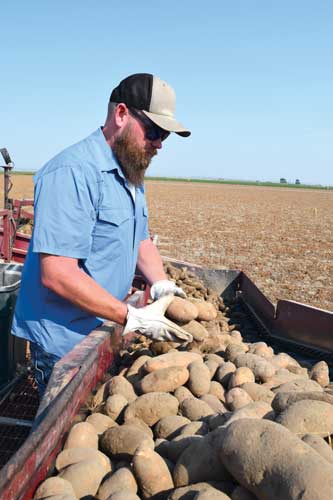
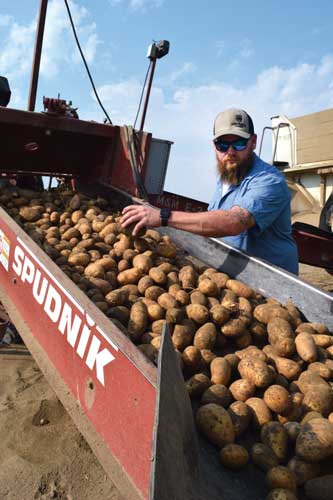
With a fleet of 14 harvesters and 28 10-wheelers, Erickson can handle seven jobs at once and has harvested up to 6,500 tons per day. This puts a lot of wear and tear on the harvesters and requires regular maintenance to keep equipment in working order, he points out.
In addition to well-oiled machines, the business requires reliable employees, which has proven challenging in recent years. With the state’s increasing minimum wage and overtime requirements, it’s become difficult to stay competitive as an agricultural employer.
“Skilled labor isn’t cheap; cheap labor isn’t skilled,” Erickson says.
Despite the challenges, Erickson would like to grow this side of the business and possibly offer custom harvesting of crops other than potatoes.
“The only time our company is actually being productive and making money is when we have tractors in the field. So the more work we can pick up and keep them busy, the better,” he says.
Growing
Erickson Farms also grows early-season processing potatoes for another farm. Varieties include Ivory Russet, Ranger Russet, Clearwater Russet, Shepody and Hamlin Russet, which was added to the mix this year and will replace Shepody next year. 2025 was a stellar year for growing early- and mid-season potatoes, Erickson says, reporting high quality and yield. Shepody, which the grower describes as a hit-or-miss variety, fared especially well, yielding up to 29.97 tons/acre, compared to the more typical 24 tons/acre.
While yield and quality were up, acreage was down due to reductions in processing contracts. This year, Erickson grew 650 acres of potatoes, a reduction of almost 70%. Contract cuts also reduced his custom harvest work by 50% to 2,500 acres this year.
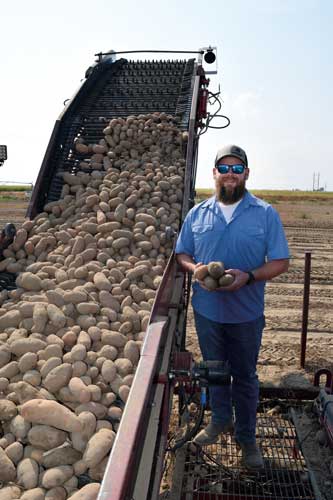
“I’ve fluctuated a couple hundred acres, but this big of a swing? This is something I’ve never experienced, and it’s going to be very interesting to see how it lines up at the end of the year,” Erickson says. “If we were going to continue at this rate, we’d have to downsize. We wouldn’t be able to have all the tractors and trucks that we have now. It’s not a fun time right now.”
On the plus side, less acreage means lower costs for some expenses such as labor, fuel and equipment repair. In addition, Erickson is trying to compensate for the acreage cuts by maximizing efficiency. He’s able to make fewer passes in the field by utilizing better tillage equipment. In addition, some of the new varieties like Hamlin Russet require less fertilizer and insecticide and come with improved tolerance to diseases like common scab, powdery scab, Verticillium wilt and soft rot.
Learning
Jordan Erickson is a second-generation farmer. His dad, Chip, moved to the area from California in 1970 and started growing alfalfa, wheat and asparagus. He added potatoes to the rotation in the mid-1990s. About a decade later, in a year that Mother Nature had dealt him a rough hand, he met some growers who needed help harvesting their potatoes. He worked for them again the next year and soon began to focus solely on custom harvesting, adding some potato acreage back into the business five years later.
“I like growing potatoes. It’s fun. I grew up doing the dirty work,” Erickson says. “When I was a little kid, I grew up in my dad’s pickup. I was that stereotypical farm boy. That’s how I was raised. My dad knew from the beginning I was going to farm.”
Erickson attended college for a year before returning to the farm 16 years ago, working his way up to managing the Washington custom harvest operation. Meanwhile, his dad manages operations in Oregon. Through the years, his dad has steered him in the right direction, while allowing him to try his own ideas and make mistakes.
“He’s the reason we have what we have, and he’s taught me everything I know about farming. I know he’s helped a lot of younger farmers over the years, and they’re successful farmers too. He’s not the guy who wants notoriety or anything, but he always has a smile on his face and wants to help everybody out. He’s always been a good neighbor,” Erickson says of his dad, adding that he’s proud to introduce himself as Chip’s son. “He’s an all-around good dude.”
Leading
Comfortable on the farm, but wanting to gain a better understanding of the potato industry, Erickson participated in the Potato Leadership, Education and Advancement Foundation’s Leadership Institute in February. The 10-day program provides an overview of the U.S. potato industry. The 2025 program began in Wisconsin with leadership training and industry tours and, as always, concluded in Washington, D.C., where participants spent time talking with lawmakers and using their voices to gain support for the industry.
The program pushed Erickson outside his comfort zone and gave him a clearer picture of the potato industry. It also provided new friendships and continued opportunities to network with the growers he met from across the country.
“I’ll call them and say ’I’ve seen this in my field. Have you seen this before?’ Now I have an extra person I can talk to instead of just people around here, where most of us have seen exactly the same things,” Erickson says.
Shortly after returning home, he joined the Washington State Potato Commission’s research committee, and he might get involved with Potatoes USA or the National Potato Council in the future.
“To be involved is beneficial for not only our company and our industry, but for me,” he says. “It’s going to help me be a better member of our industry, and I’m hoping that my involvement will help me grow, help our company grow and help our team grow.”