
|
Click to listen to this article
|
By Ben Eborn, Publisher, North American Potato Market News
The productivity gains in U.S. potato production have been impressive during the past 75 years, though there have been significant year-over-year swings in the U.S. planted area, national average yields and total production. Making projections for the 2025 potato crop has been particularly challenging due to large contract volume reductions, current market conditions, demand uncertainty, poor alternative crop prices and several other factors. In this article, we take a close look at historical U.S. potato yields, acreage and production to gain a long-term perspective on where production could be for the 2025 potato crop.
US Potato Yields
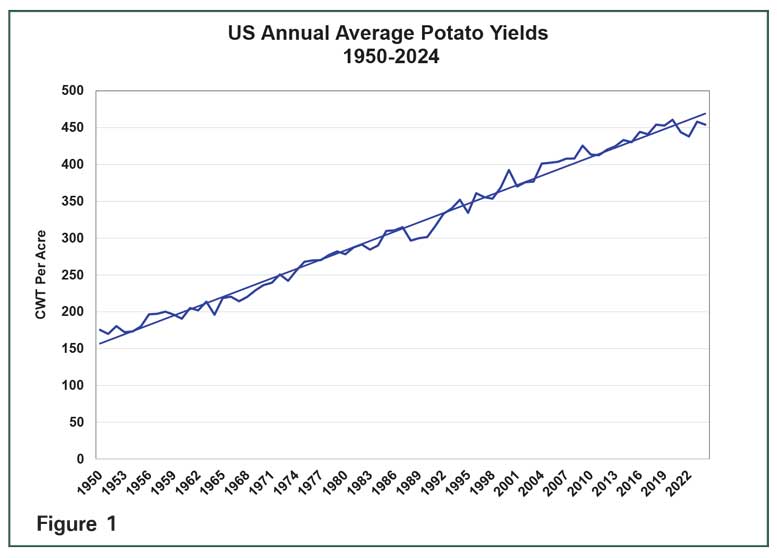
U.S. potato yields have increased by an average of 3.7 cwt per acre, per year, during the past 75 years. Yields steadily climbed from 175 cwt per acre in 1950 to a national average of 454 cwt per acre in 2024. (USDA will likely revise its 2024 yield estimate in late September.) In other words, yields have increased by 279 cwt per acre, or 159%, during the past 35 years. Though the increase in productivity has been relatively consistent, U.S. potato yields have fallen below the trendline during each of the past four years.
The 20-year trend yield for the 2025 crop is 463 cwt per acre. That is 9 cwt per acre more than the current estimate for the 2024 crop, but it is only 5 cwt per acre more than the 2023 yield and 2 cwt per acre more than the 2020 yield. Statistically, the long-term trend yield is most likely to occur; however, there are many factors that can boost yields above trend or hold them below trend.
Most growers across the U.S. have finished planting their 2025 potato crop. In the Pacific Northwest and several other major production areas, growers were able to finish planting ahead of the five-year average pace. In addition to favorable planting conditions, the weather has been nearly ideal for early crop development. There is still a lot of time between now and the end of harvest; nevertheless, the 2025 crop has the potential to reach or exceed the long-term trend.
US Potato Acreage
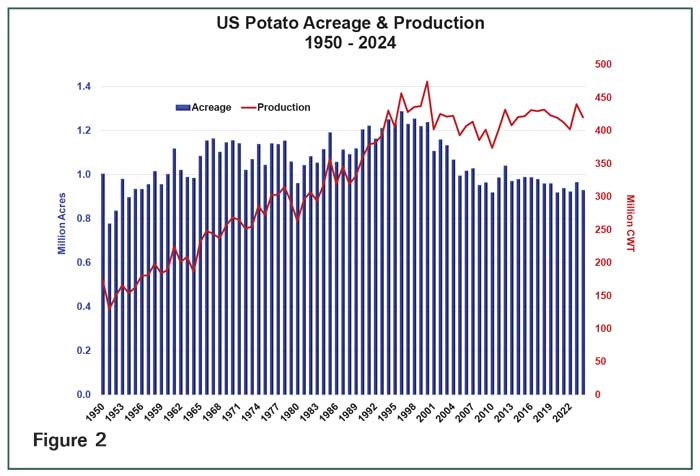
U.S. growers planted 1.005 million acres of potatoes in 1950. Potato acreage fell to a low of 778,000 acres in 1951. The U.S. planted area peaked in 1996 at 1.228 million acres. A close look at Fig. 1 shows that U.S. potato acreage fell sharply from the high in 1996 to the modern low of 919,000 acres in 2010. Between 2010 and 2024, (excluding 2012 when growers planted 1.041 million acres) U.S. potato acreage has stayed in a 70,000-acre range, between 919,200 acres and 989,600 acres. U.S. acreage has been relatively flat since 2013. In 2024, U.S. growers planted 930,000 acres of potatoes. (USDA also will likely revise its 2024 planted area estimate in September.)
Estimating the 2025 planted area has been especially challenging. Contract volume reductions, the lack of profitable alternative crops, and investments in storage facilities, equipment and other inputs may have encouraged growers to plant more uncontracted potatoes than they normally would. However, growers may have stuck to contract volumes due to financial risk, poor open-market prices and capital constraints. USDA’s first potato acreage estimate will be available on June 30.
US Potato Production
U.S. potato growers continue to increase overall production with fewer and fewer acres. Back in 1950, U.S. growers produced 174 million cwt of potatoes on 1.005 million acres. As Fig. 2 shows, U.S. potato production increased steadily from 1951 until it peaked at 474 million cwt in 2000. Since 2000, production has fallen by 11.4%. In 2024, U.S. potato production totaled 420 million cwt, with 930,000 acres planted.
How large will the 2025 potato crop be? I’m not going to attempt to answer that question in this article. However, if yields for the 2025 crop reach the trendline yield of 463 cwt per acre, then growers would only need to harvest 908,000 acres of potatoes to produce a crop the same size as the 2024 crop. Average abandonment would suggest that the planted area would need to be approximately 914,000 acres. In other words, at the trendline yield, the 2025 planted area could drop by 16,000 acres, or 1.7%, and production would match the 2024 crop.