|
Click to listen to this article
|
Story and photos by Denise Keller, Editor
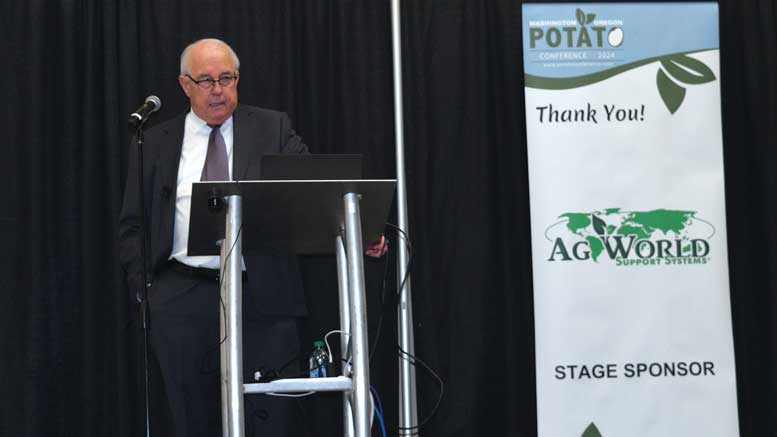
There’s good news and bad news in Washington state’s agriculture industry, according to a “state of the state” type address delivered by Derek Sandison, director of the Washington State Department of Agriculture. Sandison spoke during the Washington-Oregon Potato Conference held in Kennewick, Washington, Jan. 28-30, covering areas of concern and some bright spots in Washington agriculture.
Starting with some stats, Sandison said the number of farms in the state has been on the decline since 2017, with about 32,000 farms operating in 2022. Ownership of those farms has been changing, as well, with Washington farms seeing more outside ownership from entities such as equity firms. This leaves fewer multi-generational farms and less local ownership than in the past, and Sandison is concerned about what that means for rural communities going forward.
Despite these trends, most of the state’s farms remain family owned and 89% are considered small farms, with the majority under 50 acres. The median size farm is 30 acres and generates about $5,000 per year, pointing out a big range of scale in Washington agriculture.
In 2023, the state’s crops and livestock had a farm gate value of $12 billion, a $650 million decrease from 2022. The state produces more than 300 different crops, a level of diversity that sets the state apart from many others, Sandison said. Apples are the state’s top commodity, while potatoes rank fourth with a value of $1.16 billion. The state exports $7 billion of ag products, with Canada being the top market, followed by Japan, China, Mexico and South Korea. Frozen potato products are the top export product, valued at $1.1 billion.
Sandison listed several factors that are driving industry consolidation and affecting profitability including high costs, regulatory burdens, labor shortages and climate issues. He also mentioned that the Washington State Department of Agriculture is focusing on policies supporting farm viability, workforce development, infrastructure, and market access to boost long-term agricultural success. The state is also continuing to work to improve the water supply for irrigators in the eastern portion of the Columbia Basin Project through the Odessa Groundwater Replacement Program. Sandison noted that more than 75% of the state’s crop production value comes from irrigated agriculture, making water availability vital to the future of the industry.
Finally, when asked about his thoughts on newly elected Washington Gov. Bob Ferguson, Sandison expressed optimism. After the November election, Ferguson formed a transition team and created an ag sub-committee within that team. The sub-committee came up with several recommendations that would support the ag industry, including fixing some shortcomings related to the ag exemption in the Climate Commitment Act.
“I’m actually encouraged by what I’ve seen,” Sandison said. “I’m encouraged that it’s going to be a more receptive administration in terms of agriculture.”