|
Click to listen to this article
|
Story and photos by Dave Alexander, Publisher
If you’re shopping on Amazon for a new TV, or a new computer or a new-fangled widget you don’t need, chances are good that you read the reviews before smashing the “buy” button. But what if you want to know how well a product works that isn’t intended for mass consumption? Something that doesn’t have 5,000 Amazon reviews.
If you need a new tractor or planter or harvester, you can talk to neighbors and other growers you trust because every farm will have some variation of this equipment. But what about newer technology like drone sprayers? Reading an ad or website will tell you what is does, but if you want to know how drone sprayers actually work in the field, read on.
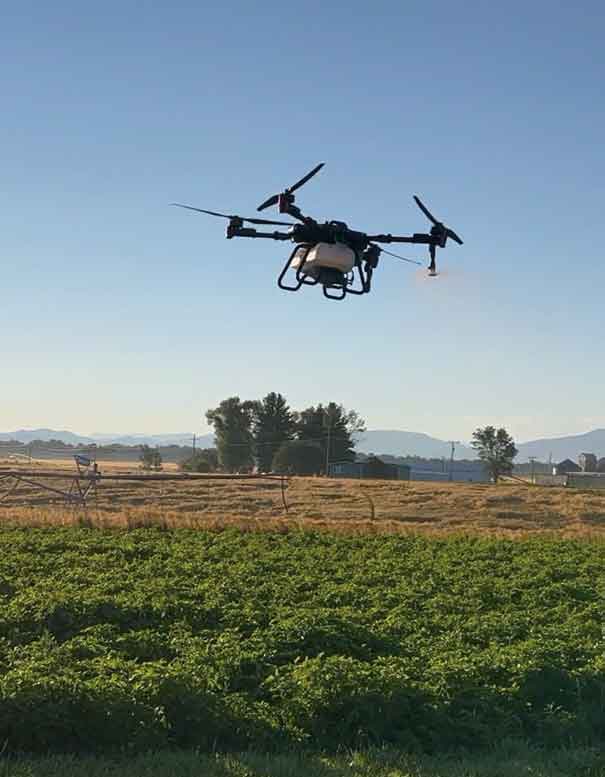
Speaking at the Montana Seed Potato Seminar in Missoula, Montana, tech enthusiast Willem Kimm gave attendees his real-world experience using an XAG P100 Pro drone sprayer this past season on seed plots at Kimm Seed Potatoes.

Why Drones?
Father and son, Jason and Willem Kimm’s potato seed plots are five miles away from their main farm, on the edge of Bozeman, Montana. Towing a large spray rig on busy roads was always dicey, and spraying by plane risks exposure to neighboring fields and wasn’t even possible on their smallest plot. Jason used a makeshift sprayer he built from a rogueing cart, but it was difficult to run and inefficient.
Drones have better topographical access, are more cost-effective on small plots than large rigs, deliver liquids more accurately with less drift, and can be used for dry fertilizer and even seed. They can also target problem areas, increasing or decreasing application rates on the fly. The capabilities seemed to solve a lot of problems at Kimm Seed, so they made the investment.
Got Time?
The rugged, high altitude-capable XAG drone with an easy-to-clean atomizing disk system checked all the boxes for the Kimms when they went shopping, but there are licensing considerations that may cross one off your list.
The FAA requires three different licenses to fly large commercial drones. Part 107 allows for commercial, non-recreational flight, Part 137 authorizes agriculture spraying, and Part 137 Exemption allows for drones over 55 pounds, needed for heavy ag drones.
To get all these certifications, you’ll have to pass written exams and a physical exam, understand weather patterns and fronts, know airspace rules and sectional charts, and understand regulations and aeronautical processes. Suffice it to say, you’ll need time to study before you can fly, and it can take months to get licensed.
In the Field
Kimm Seed uses a trailer with a 10 kw generator to charge batteries when spraying. A total of six batteries are used – two on the drone, two on the charger and two ready to swap in.
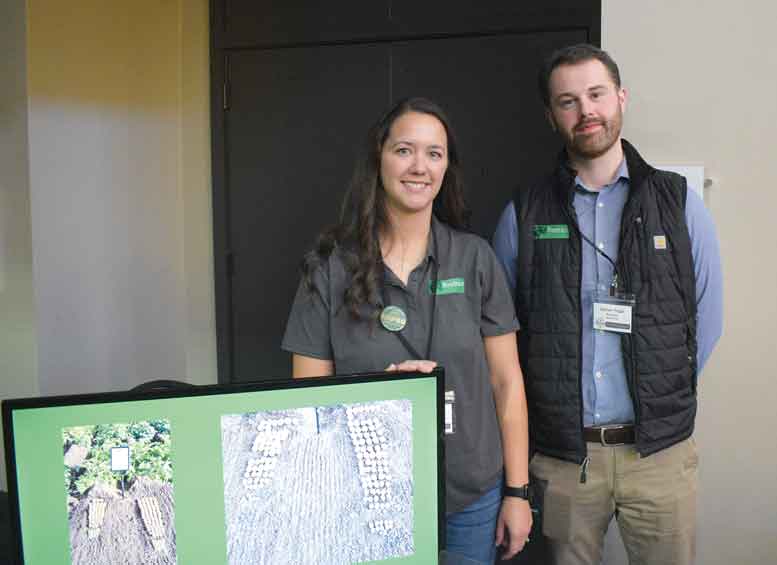
But before spraying can start, an aerial map needs to be made and the data needs to be processed. Kimm uses a small DJI drone and PIX4D mapping software for this. There is one Kimm plot close to the Bozeman airport, so documentation has to be filed pre-spray every time they fly in that restricted airspace.
The drone actually pilots itself and controls its own flight from the mapping data, but two people are required to operate large agricultural drones efficiently. One person is batching and filling spray tanks, while the other is swapping batteries, and both people watch the laptop and recalibrate spray rates as needed to ensure what is seen on-screen matches what is seen in the tanks.
The XAG drone holds 13.2 gallons, which is 110 pounds of fluid. Maximum takeoff weight is 255 pounds, and fully loaded, the drone will fly for seven minutes without changing batteries. Spraying at 4 gallons per acre, Kimm has found their drone averages about 30 acres per hour, well below what the manufacturer claims.
Real-World Results
Though slower than planes or ground rigs, the Kimms have found the ease of access to remote fields, flexibility that the drone provides, and accurate sprays with less drift made their drone a wise purchase. They did have to work through a learning curve, FAA compliance and glitchy software at times, as expected with all new technology.
Perhaps the biggest impediment when employing a drone sprayer is the tech itself. For Willem Kimm, a self-proclaimed tech lover, he adapted to his drone intuitively, but if you are someone who isn’t “techy,” you’ll have more significant challenges getting up and running. He recommends getting training from the manufacturer as he knows of people who have crashed their drones when trying to learn on their own.
“We haven’t crashed ours yet,” Kimm said.
Future or Fad?
Drone spraying has certainly found a spot at Kimm Seed Potatoes, but there are issues to keep an eye on for future use.
A commercial drone ban has been talked about in political circles. Chinese-made DJI, in particular, has been accused of spying and collecting geographic data. Kimm doesn’t see a ban happening, but acknowledged it is a possibility.
Better batteries, swarm spraying, and more controlled and more precise spot spraying are already in the works. Five years from now, technology will be completely different, possibly making a drone bought today obsolete. Technology keeps advancing at a rapid rate, and the possibilities excite and energize young growers.
Kimm envisions a fully autonomous farm one day, operating 24/7. For now, he’ll keep spraying with their drone and the farm may even invest in another one for the coming season. He said he loves their drone, but there are certainly challenges. If he was rating it on Amazon, he would give it four out of five stars.